Are Countries Selling Israel Weapons Violating International Law?
The U.K.’s prime minister received a letter signed by 600 lawyers and academics warning that the country’s arms sales to Israel are violating international law. Are they right?
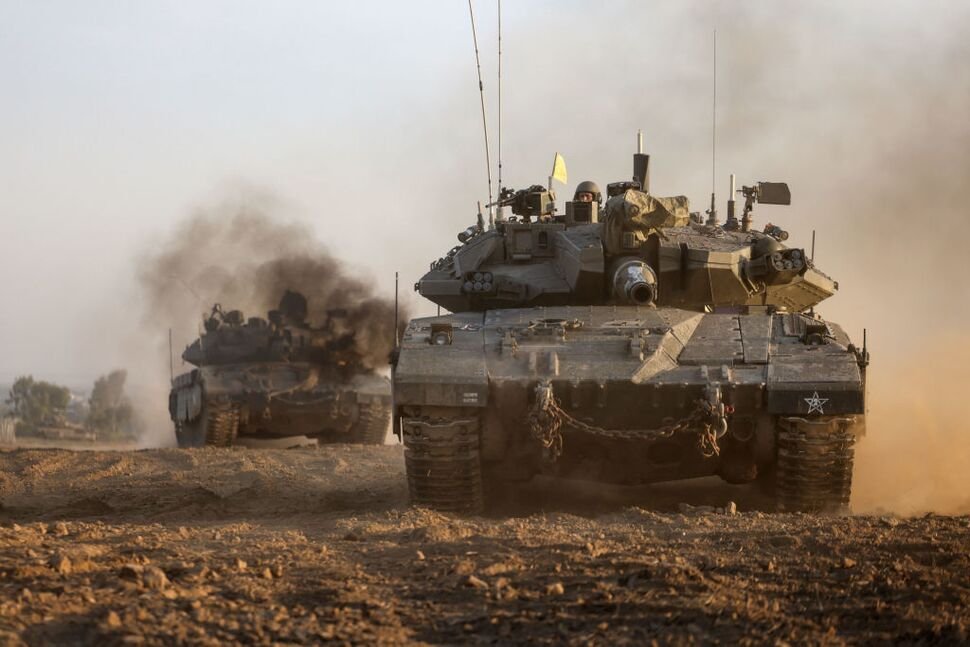
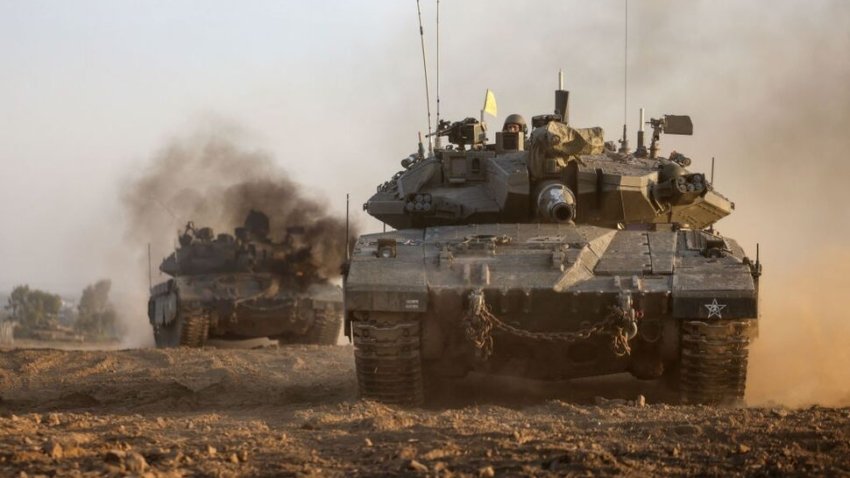
Israeli military tanks roll approach the border of the Gaza Strip, on Dec. 3, 2023.
By Lawrence Hill-Cawthorne | The Conversation
The U.K. government has received internal legal advice that Israel has broken international humanitarian law in its current war on Gaza. The advice was revealed by Alicia Kearns, the Conservative chair of the House of Commons foreign affairs select committee, in a speech to a fundraising event on March 13 and leaked to the U.K.’s Observer newspaper.
An Israeli-Palestinian Conflict Timeline
The paper quoted British barrister and war crimes prosecutor Sir Geoffrey Nice as saying: “Countries supplying arms to Israel may now be complicit in criminal warfare. The public should be told what the advice says.”
The Guardian has now revealed that the prime minister, Rishi Sunak, has since received a letter signed by 600 lawyers and academics, including three former supreme court justices – among them Baroness Hale, the court’s former president – as well as former court of appeal judges and more than 60 KCs, warning that U.K. arms sales to Israel are also illegal under international law.
But what does international law actually say on this issue, and what are the U.K.’s (and other nations’) legal obligations in relation to the ongoing assault on Gaza?
In recent months, a number of countries have announced they are suspending arms exports to Israel. These include Canada, Belgium, Italy, Spain and the Netherlands, as well as the Japanese company Itochu Corporation. Germany and the U.S. – by far the biggest suppliers of arms to Israel – have not as yet signalled intentions to follow suit.
Neither has the U.K.. But with arms exports amounting to £42 million in 2022, it is not one of Israel’s major suppliers.
Suspending arms exports to Israel indicates not only political concerns, but also fear over the legality of continuing to support Israel militarily in its assault on Gaza. The Netherlands court of appeal ruled in February that the Dutch government must discontinue its sales of F35 fighter jet parts on the basis of its obligations under the U.N. arms trade treaty. A similar lawsuit is currently pending in Denmark which exports F35 parts to the U.S., which then sells the finished jets to Israel.
Aid Work Gets Riskier in Conflict Zones
In the U.K., the high court dismissed an attempt to challenge the government’s continued licensing of arms exports to Israel. But this was because the particular procedural hurdle that applicants in such cases have to get over is notoriously high. The judgment said nothing definitive as to Israel’s (or the U.K.’s) compliance with international law.
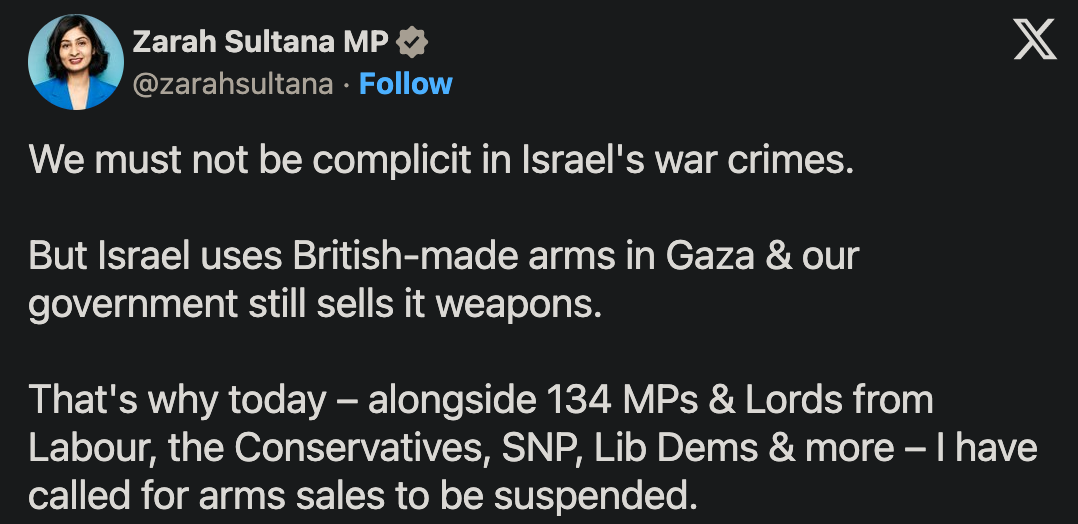
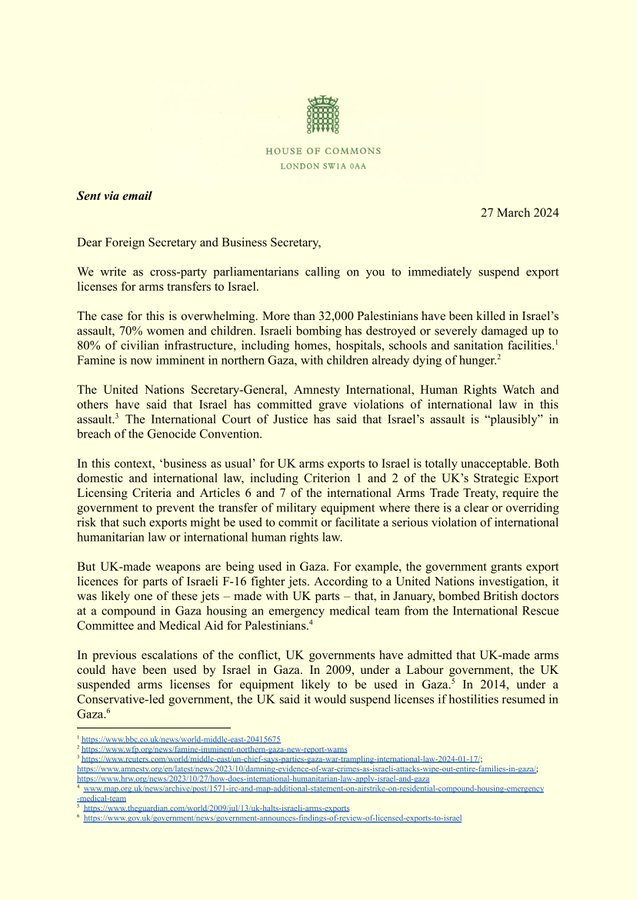
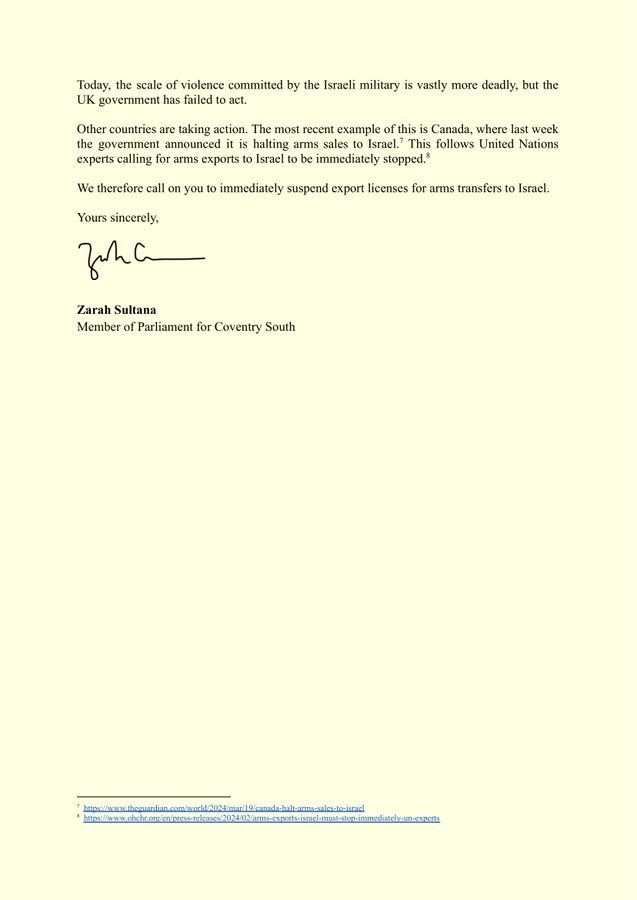
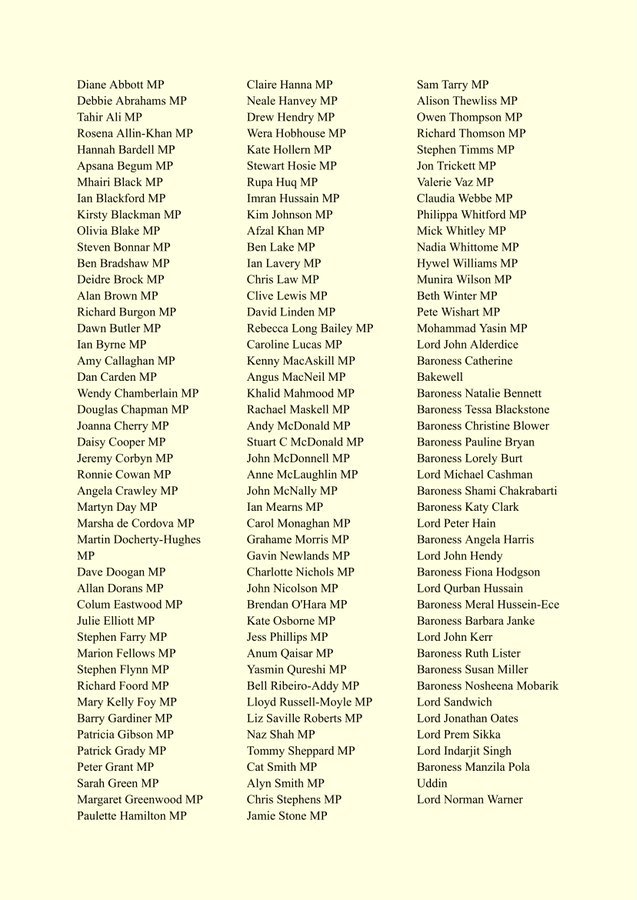
Following this, 130 MPs and peers from across party lines recently signed a letter to the foreign secretary calling on the government to suspend arms exports to Israel.
Arms Trade Treaty
So what is the position under international law of countries, such as the U.K., that support Israel militarily? There are many specific and general rules of international law that are relevant here.
The most obvious, and the one emphasised in the British MPs’ letter, is found in the U.N. arms trade treaty, to which the U.K. is a party. Article 7 requires a risk assessment for all weapons transfers, and prohibits exports where there is an overriding risk that the weapons could be used to commit serious violations of international humanitarian law (the law of armed conflict).
Is the Two-State Solution Dead?
The only objective test we have for determining risk of future violations is to examine whether there is evidence of a pattern of past violations by Israel. U.N. reporting of past serious violations is one of the key considerations that the U.K.’s own policy points to in determining future risk. In 2019, the U.K. court of appeal suspended arms exports to Saudi Arabia based on the government’s failure to assess whether past violations of international law had likely been committed in Yemen.
The available evidence suggests there have been countless examples of Israeli actions in Gaza that appear, on their face, to be inconsistent with international humanitarian law. Among the most recent examples are the Israeli attack on an aid convoy on April 1, the destruction of Gaza’s hospitals, and the well-documented famine that now engulfs the territory.
Palestinians stand near a World Central Kitchen vehicle on April 2, 2024, after three aid vehicles were targeted by Israeli strikes.
The Hague court of appeal that ordered the Dutch government to suspend arms exports to Israel relied on reports from Amnesty International and the U.N. when it listed multiple examples of apparent violations of the law of armed conflict in Gaza.
And in the long-awaited U.N. security council resolution adopted on March 25, with the U.S. abstaining, the security council condemned “all attacks against civilians and civilian objects, as well as all violence and hostilities against civilians”, and demanded the flow of humanitarian assistance into Gaza, in line with international humanitarian law.
This suggests a pattern of past serious violations and thus a clear risk of continuing violations. So, signatories to the arms trade treaty continuing to supply weapons to Israel likely do so in breach of article 7.
EXPLAINER:
What Is NATO?
Geneva Conventions
Yet all nations have other obligations that take on particular importance in relation to Gaza. One of these is the obligation to prevent genocide under article 1 of the Genocide convention (which was the focus of the letter to the prime minister referred to above).
This is especially relevant since the International Court of Justice (ICJ) determined in January that there is an imminent risk of irreparable harm to the rights of Palestinians in Gaza under the Genocide Convention.
But it also includes article 1 of the 1949 Geneva conventions, which requires states to “ensure respect” for international humanitarian law. There is overwhelming support for the view that this requires all states not only to avoid aiding or assisting violations (for example, through arms exports) but to take proactive steps to ensure warring parties comply with their obligations under international law. They can do so via diplomatic channels or by imposing sanctions.
On March 1, Nicaragua instituted proceedings before the ICJ against Germany (the second-biggest arms exporter to Israel), in part alleging that it is violating article 1 of the Geneva conventions due to its support for Israel.
In this way, all countries are legally obliged to ensure that others comply with international humanitarian law. If the catastrophic destruction, massive civilian death toll and immense suffering of those still alive in Gaza is not enough to pull Israel’s allies into line over their continuing arms sales, it is difficult to conceive of any situation that ever could.
Lawrence Hill-Cawthorne, Associate Professor of Law, University of Bristol
This article is republished from The Conversation under a Creative Commons license. Read the original article that was originally published on April 4, 2024.








Leave a Reply